Numbers and their mystical meaning: how to read symbols without superstitions
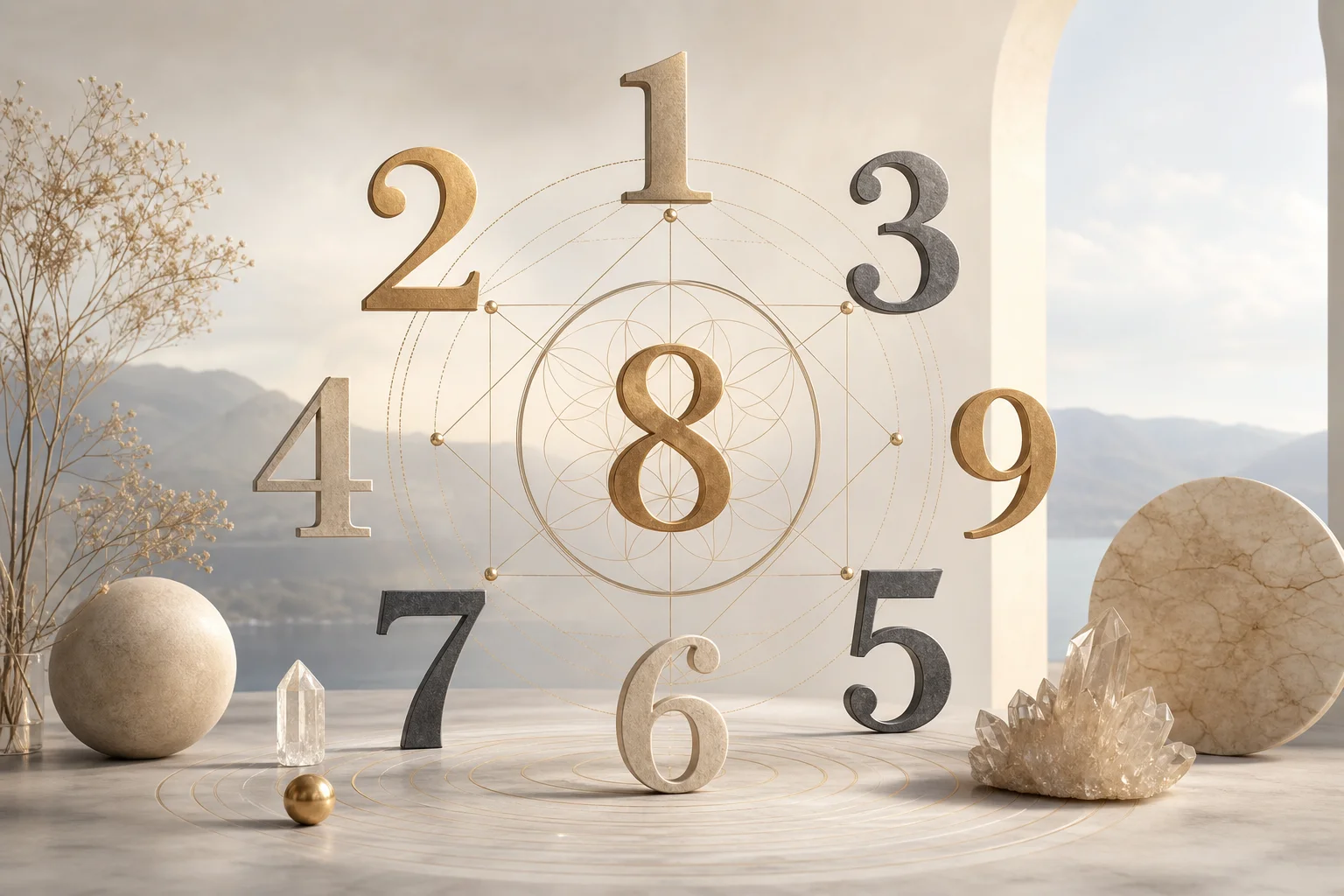
Numbers and their mystical meanings interest people not only in esotericism but also in culture, religion, art, and everyday habits. Some see hints in recurring digits, while others regard them as beautiful symbols. In this article, we will explore where numerical symbolism originated, what individual numbers usually mean, how to interpret coincidences without fanaticism, and what questions to ask oneself before drawing any conclusions.
Why people see meaning in numbers
Numbers are convenient for symbolic thinking. They are simple, repetitive, and easy to remember. Therefore, a person quickly associates them with events: the date of birth, house number, time on the clock, or an important amount.
Additionally, numbers often become part of rituals. Seven days of the week, twelve months, three wishes, forty days of remembrance—such structures create a sense of order. Over time, practical significance mixes with spiritual and cultural meanings.
It's important to understand: the mystical meaning of numbers is not a strict science. It is a system of interpretations. It can assist in self-reflection but should not replace common sense, medical, financial, or legal decisions.
How numerical symbolism was formed
Numbers gained meaning in different traditions independently of each other. Sometimes meanings coincided, sometimes they contradicted one another. For instance, the number 13 is considered ominous in some cultures, while in others it carries no negative connotation.
From antiquity to religions
In ancient philosophy, number was associated with the harmony of the world. Pythagoreans believed that numerical proportions express the order of the cosmos, music, and shape. In religious texts, numbers were often used as symbols of fullness, trials, union, or completion.
In folk culture, numbers became signs of luck or warnings. Thus, stable expressions emerged: “the third time,” “seven troubles,” “the ninth wave.” They do not require literal understanding but convey emotional meaning well.
The meanings of basic numbers in numerology and culture
Below are common interpretations. They are not universal rules. It’s better to perceive them as a dictionary of symbols that helps see a theme for reflection.
| Number | Common symbolism | Possible theme for reflection |
|---|---|---|
| 0 | Emptiness, potential, beginning of a cycle | What is yet to manifest? |
| 1 | Unity, will, leadership | Where do I need to take initiative? |
| 2 | Partnership, choice, balance | How can I establish dialogue? |
| 3 | Creativity, growth, expression | What do I want to create? |
| 4 | Structure, home, order | Where is discipline needed? |
| 5 | Change, movement, freedom | What needs updating? |
| 6 | Care, family, responsibility | Who needs support? |
| 7 | Search for meaning, knowledge, solitude | What should I learn? |
| 8 | Strength, resources, management | How do I handle power and money? |
| 9 | Completion, wisdom, letting go | What should I finish? |
Zero
Zero is often associated with emptiness and infinite potential. It resembles a pause before the beginning. In spiritual interpretations, zero can indicate resetting old experiences, readiness for a new phase, or the need to slow down.
One
One symbolizes beginnings, independence, and will. It helps to address one’s personal position. If one often attracts attention, one might ask: “Where am I avoiding a decision?” or “In which area should I act on my own?”
Two
Two is connected with pairing, choice, and relationships. It is the number of dialogue, diplomacy, and balance. In practical terms, it reminds us that not every situation is resolved by force. Sometimes, it is more important to hear the other side.
Three
Three is associated with creativity, development, and expressiveness. In myths and fairy tales, it often denotes the completeness of action: three trials, three roads, three attempts. Therefore, the number three can conveniently be interpreted as a sign of movement from idea to result.
Four
Four is the symbol of a foundation. Four corners of the world, four seasons, four angles of a house create an image of stability. If this number seems significant, one should pay attention to routine, health, documents, daily life, and long-term plans.
Five
Five is associated with change and freedom. A person has five fingers on one hand, and in traditional systems, five elements or directions are commonly highlighted. Symbolically, this number speaks of flexibility, travel, experimentation, and breaking out of routine.
Six
Six often relates to care, beauty, and responsibility. It is associated with family, service, and harmony of space. However, it can also warn about the other side: excessive control, the desire to save everyone, or neglecting one’s own boundaries.
Seven
Seven is one of the most well-known “mystical” numbers. Seven days of the week, seven notes, seven colors of the rainbow have made it a symbol of hidden order. In personal interpretations, seven typically speaks of knowledge, inner search, intuition, and the need for silence.
Eight
Eight resembles the infinity sign if turned horizontally. It is associated with strength, material resources, power, and the consequences of actions. This number often prompts thoughts about fair exchange: what am I taking, what am I giving, and what am I managing?
Nine
Nine concludes the series of single-digit numbers. Therefore, it is often considered a symbol of conclusion, wisdom, and letting go. It does not necessarily imply an ending in a negative sense. Rather, it invites one to close an old chapter and make room for the next.
Repeating numbers and “angelic” combinations
Repeating numbers on clocks, receipts, or license plates are often called “angel numbers.” Popular examples include 11:11, 22:22, 333, or 777. In the esoteric community, they are ascribed messages, support, or warnings.
A more cautious approach would suggest: a repeated number might be a reason to stop and notice one’s state. For instance, if you constantly see 11:11, it’s not necessary to look for a ready-made prediction. It’s better to ask: “What was I thinking at that moment?” “What decision am I postponing?” “What repeats in my life?”

How to interpret numbers without superstitions
To ensure the mystical meaning of digits is useful rather than troubling, apply a simple algorithm.
- Record the number and context. Write down where you saw it: time, date, number, amount, dream, or important document.
- Describe the emotion. Did the number scare, calm, surprise, or inspire you? The first reaction is often more important than the combination itself.
- Check personal associations. For one person, 4 means order, while for another, it’s an unpleasant date. Personal experiences change the meaning.
- Compare with cultural meanings. Use numerology and symbolism as a reference, not as a verdict.
- Formulate a practical conclusion. A good interpretation leads to action: to talk, to rest, to finish a task, to revise a plan.
- Do not make important decisions solely based on numbers. If the question pertains to money, health, or safety, rely on facts and specialists.
Such an approach makes numerical signs a tool for awareness. It reduces anxiety and helps avoid turning randomness into a source of fear.
Birth number and personal numerology
In popular numerology, people often calculate the “life path number.” To do this, the digits of the birth date are summed to a single-digit number. For example, for the date 14.08.1992, the calculation looks like this: 1 + 4 + 0 + 8 + 1 + 9 + 9 + 2 = 34, then 3 + 4 = 7.
This number is interpreted as an image of character or life theme. However, it should not be taken too literally. A birth date does not override upbringing, choices, environment, education, and personal efforts. It’s better to use the calculation as a question to oneself: “What qualities am I developing?” and “What scenarios are repeating?”
Where numbers appear in everyday symbolism
Numbers surround us constantly. Their mystical meanings are most often sought in several situations:
- time on clocks, especially with repetitions like 10:10 or 12:12;
- birth dates, wedding dates, moving dates, or important decisions;
- house numbers, apartment numbers, car license plates, and telephone numbers;
- amounts in receipts and bank transactions;
- dreams where the number stands out particularly vividly;
- chance coincidences that repeat several times.
At the same time, it’s worth remembering the work of attention. When a person becomes interested in a certain number, they start to notice it more frequently. This is not always a “sign of fate.” Sometimes, it’s a natural characteristic of perception.
Frequently asked questions about the mystical meaning of numbers
What does the number 11:11 on a clock mean?
Most often, 11:11 is interpreted as a symbol of synchronicity, beginnings, and attentiveness to thought. The practical meaning is simple: take a minute to check what you are thinking about and what decision is important right now.
Does the number 13 only have bad significance?
No. The negative reputation of the number 13 is associated with certain cultural traditions. In other contexts, it can signify transition, renewal, or simply carry no particular meaning.
Which numbers are considered the most mystical?
Often, 3, 7, 9, 11, 22, and 33 are highlighted. They are associated with fullness, spiritual searching, completion, intuition, and mastery. However, meanings depend on the interpretation system used.
Can one fully trust numerology?
It’s better to view numerology as a symbolic language rather than as an exact prediction. It can help in self-analysis but should not manage your life in place of reason and experience.
What should I do if one number constantly frightens me?
First, check what it personally relates to for you. Write down events and thoughts that arise around it. If anxiety increases and disrupts your life, it’s better to discuss it with a psychologist rather than seeking more interpretations.
How to use numerical symbols beneficially
Numbers can be a gentle way to bring order to your thoughts. For example, seven may remind you of the need to learn, four of your routine, and nine of completing old tasks. This approach does not require blind faith.
Try to choose one number that currently attracts your attention and ask yourself three questions: what does it mean to me, what theme is repeating through it, and what small action can I take today? It is action that distinguishes useful symbolism from empty guessing.
Conclusion
Numbers and their mystical meanings unfold best when you connect cultural knowledge, personal associations, and common sense. Do not rush to find ready-made answers in every digit. Observe, record coincidences, ask precise questions, and turn symbols into concrete steps: finish what is extraneous, strengthen what is important, start anew, or simply pay more attention to yourself.