Numbers and luck: how people associate digits with fortune
Numbers and luck have long been intertwined in culture, daily life, and personal habits. Some choose a "lucky" date for their wedding, others avoid the 13th floor, while some bet on their favorite number in the lottery. In this article, we will explore where the notions of lucky and unlucky numbers come from, how they operate from a psychological standpoint, the differences in traditions across countries, and how to use these symbols without excessive expectations.
Why do people associate numbers with luck
Numbers seem neutral: they help count money, measure time, and plan routes. However, people rarely perceive the world solely rationally. We search for patterns, even when events are random. Thus, a birth date, an apartment number, or a combination on a ticket can gain personal meaning.
There are several reasons why a number begins to seem lucky:
- it is associated with a pleasant event;
- it often recurs during significant moments;
- there is a strong cultural tradition around it;
- it is easy to remember and distinguish from others;
- a person attributes meaning to it themselves.
For instance, if an important victory occurred on the 7th, that number might become a personal symbol of success. This does not prove that the number controls the future. But it can enhance confidence, and confidence sometimes helps one act bolder.

Lucky numbers in different cultures
Perceptions of numbers depend on language, religion, history, and everyday associations. The same number can be considered lucky in one country and alarming in another.
Number 7
The number seven is often perceived as lucky in European and Russian traditions. It appears in fairy tales, religious texts, and idioms: seven days of the week, seven wonders of the world, "measure twice, cut once." Because of this, the number 7 has become a symbol of completeness, order, and finality.
In daily life, people often choose seven for passwords, IDs, bets, and memorable dates. However, it is essential to remember: the popularity of a number does not make it a magical tool. Rather, it functions as a cultural sign that is widely understood.
Number 8
In Chinese culture, the number 8 is considered particularly auspicious because its pronunciation resembles a word associated with wealth and prosperity. Because of this, eights are frequently chosen for phone numbers, cars, apartments, and business dates.
This illustrates how language influences perception. A number gains positive meaning not on its own but through sound and tradition. Thus, lucky numbers can vary significantly from country to country.
Number 13
In Western culture, 13 is often called an unlucky number. Various historical and religious explanations are associated with it, but no single proven reason exists. Nevertheless, the fear of the number 13 has become so widespread that some buildings skip the 13th floor, and people avoid making significant decisions on Friday the 13th.
From a psychological perspective, this is an example of a self-fulfilling belief. If a person anticipates misfortune, they are more likely to notice any failures on that day. Lucky events, on the other hand, are easily overlooked.
Number 4
In some East Asian countries, the number 4 can be seen as unfavorable because its pronunciation sounds similar to the word “death.” Therefore, hospitals, hotels, and residential buildings sometimes avoid fourth floors or rooms with a high number of fours.
For Russian-speaking readers, such an association may not be obvious. This is confirmed by the simple fact: the "luck" of a number often arises not from a universal law but from a specific cultural context.
Numerology and reality: where is the boundary
Numerology considers numbers as symbols that allegedly describe personality, fate, and life cycles. Many people turn to it out of curiosity or as a means of self-reflection. For example, a birth date may be seen as an opportunity to think about habits, goals, and strengths.
However, there is no scientific evidence that numbers themselves predict fate. Therefore, it is better to regard numerology as a cultural practice or personal ritual rather than an accurate forecast. This approach helps maintain interest without substituting decisions with superstitions.
A useful guideline is simple: if a number inspires you, reminds you of your goals, or helps set the mood, it can be a personal symbol. If it causes you to avoid an important step without reasonable justification, it’s worth pausing and re-evaluating your reasoning.
How to choose a lucky number for yourself
A personal lucky number does not need to coincide with popular symbols. For one person, it may be 7; for another — 21, 28, or 101. The main thing is that the number holds a clear and positive meaning specifically for you.
Step-by-step method to choose a personal number
- Recall important dates. Write down days when good events occurred: meetings, moving, victories, project starts.
- Identify repeating numbers. Look at which digits often appear in your pleasant memories.
- Check associations. Ask yourself what the number evokes: calmness, energy, joy, confidence.
- Avoid pressure. Do not choose a number just because it is considered fashionable or “powerful.”
- Use it as an anchor. Add the number to your planner, goal, workout plan, or personal ritual.
- Do not shift responsibility. Decisions should be based on facts, and the number can merely support your mindset.
This method is safe and practical. It does not promise miracles but helps create a personal symbol of motivation.
Popular numbers and their meanings
Below is a brief table with common associations. It does not represent a universal rule but helps compare cultural meanings.
| Number | Common association | Where it appears | How to use consciously |
|---|---|---|---|
| 3 | growth, movement, balance | fairy tales, proverbs, speech structure | as a symbol of simplicity and a completed idea |
| 7 | luck, completeness, order | religion, calendar, folklore | as a personal sign of confidence |
| 8 | sufficiency, prosperity | Chinese culture, business environment | as a symbol of financial goals |
| 9 | completion, experience, maturity | spiritual and philosophical traditions | as a reminder to summarize |
| 13 | risk, disruption of order | Western superstitions | as a reason to examine fears, rather than avoid action |
| 4 | stability or anxious association | various cultural contexts | consider meaning in specific countries |
The table shows that the meaning of a number changes. Therefore, before drawing conclusions, it is helpful to consider the context: your experience, language, tradition, and specific situation.
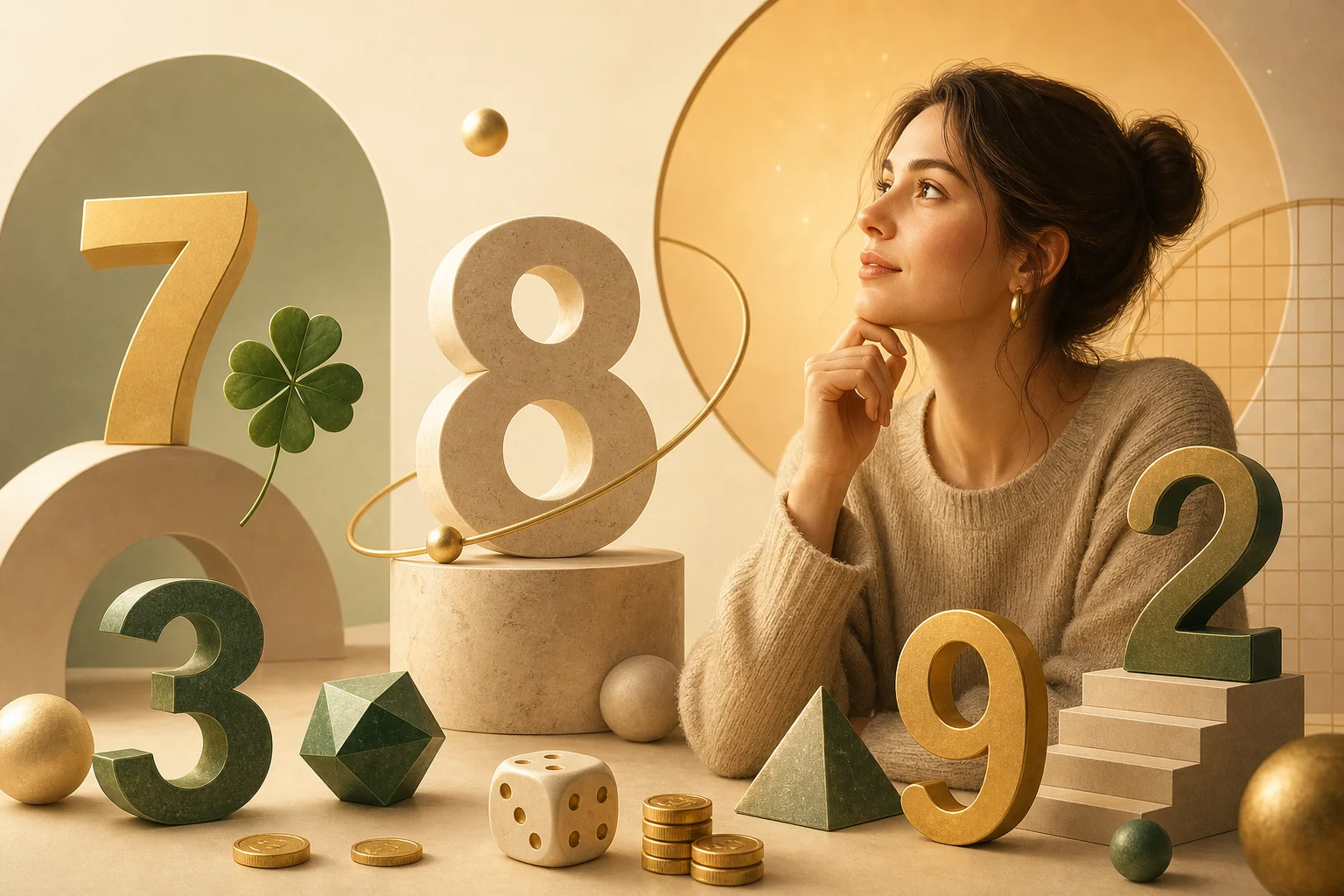
Psychology of lucky numbers
Belief in lucky numbers is linked to several psychological mechanisms. The first is pattern-seeking. The brain tries to quickly connect events to better navigate the world. Sometimes this is helpful. But other times, we see a connection where there is only coincidence.
The second mechanism is confirmation bias. If a person believes that the number 7 brings luck, they will remember a win on the 7th and forget typical days without results. Thus, the belief grows stronger, even if there is little objective data.
The third mechanism is the feeling of control. Randomness can be disturbing. A personal number, talisman, or ritual creates a sense of order. This can reduce stress before an exam, presentation, or difficult meeting. But moderation is vital here. The ritual should help, not manage life.
When belief in numbers is helpful, and when it hinders
Symbols can provide support. For example, an athlete may choose a number that reminds them of their first victory. An entrepreneur may schedule a project launch on a special date to make the event easier to remember and create an emotional setting.
However, belief in numbers becomes problematic if it replaces analysis. One should never choose an investment solely based on a "lucky" contract number. Do not postpone treatment, an interview, or a trip just because a date seems unlucky. In such cases, it is better to rely on information, timelines, health, and expert advice.
A practical rule is: a number can be a symbol, but it should not be the only argument.
How to use numbers and luck in everyday life
If you resonate with this theme, use numbers as a gentle motivational tool. For instance, aim to read 7 pages daily, take 8,000 steps, or save a fixed amount for 13 weeks in a row. This way, a number transforms from superstition into a convenient structure.
Numbers also help create personal traditions. You can mark the day you started a project, select memorable dates for family events, or use a favorite digit in your workspace design. The main thing is to maintain the freedom to choose and not fear “wrong” numbers.
Frequently asked questions about numbers and luck
What numbers are considered the luckiest
The numbers most frequently regarded as lucky are 7 and 8, but this depends on culture. In Russian-speaking areas, seven is popular. In Chinese tradition, eight has strong positive associations.
Can you calculate your lucky number based on your birth date
You can use your birth date as a symbolic reference, such as summing the digits of the date. But this calculation has no proven predictive power. It is better to view it as a self-discovery method or personal ritual.
Is it true that the number 13 brings bad luck
There is no reliable evidence that the number 13 itself causes misfortune. Its reputation is tied to cultural superstitions and expectations. If a person fears 13, they may be more likely to notice negative events on that day.
What to do if I see the same number repeatedly
First, check standard reasons: schedules, route numbers, time on the clock, regular places. A repeating number may feel significant due to your attention to it. If it inspires you, use it as a reminder of your goal.
Should wedding or project launch dates be chosen by numbers
You may choose a beautiful or significant date if it creates joy and convenience. But do not overlook practical factors: venue availability, budget, timelines, weather, and participant readiness.
Conclusion: how to relate to lucky numbers wisely
Numbers and luck are primarily connected through culture, personal experience, and psychology. A lucky number can support, inspire, and remind you of your goals. However, it does not replace planning, knowledge, and responsibility. Choose a number that gives you peace or energy, use it as a motivating symbol, and make important decisions based on facts rather than fear of digits.