Popular unlucky numbers and their significance in different cultures
Popular unlucky numbers are not just amusing superstitions. In many countries, they influence daily life, architecture, the choice of dates, phone numbers, and even marketing. Most often, the fear of a number is connected to religion, linguistic associations, historical events or established cultural associations. In this article, we will explore the most well-known "bad" numbers, explain their origins, and show where they are taken particularly seriously.
What are unlucky numbers
An unlucky number is one that people attribute negative meanings to: misfortune, death, illness, betrayal, poverty, or danger. Such beliefs rarely arise by accident. Usually, they are based on one of three factors:
- religious narrative or myth;
- phonetic similarity with a word that has a bad meaning;
- historical or everyday tradition reinforced by generations.
It is important to understand: numbers themselves do not possess proven mystical power. However, belief in them can have a real impact on people's behavior. For instance, a person may refuse to buy an apartment with an "unlucky" number or reschedule a wedding to another date. Therefore, unlucky numbers are of interest not only to numerologists but also to cultural scholars, psychologists, developers, hoteliers, and brands.
The most well-known unlucky numbers in the world
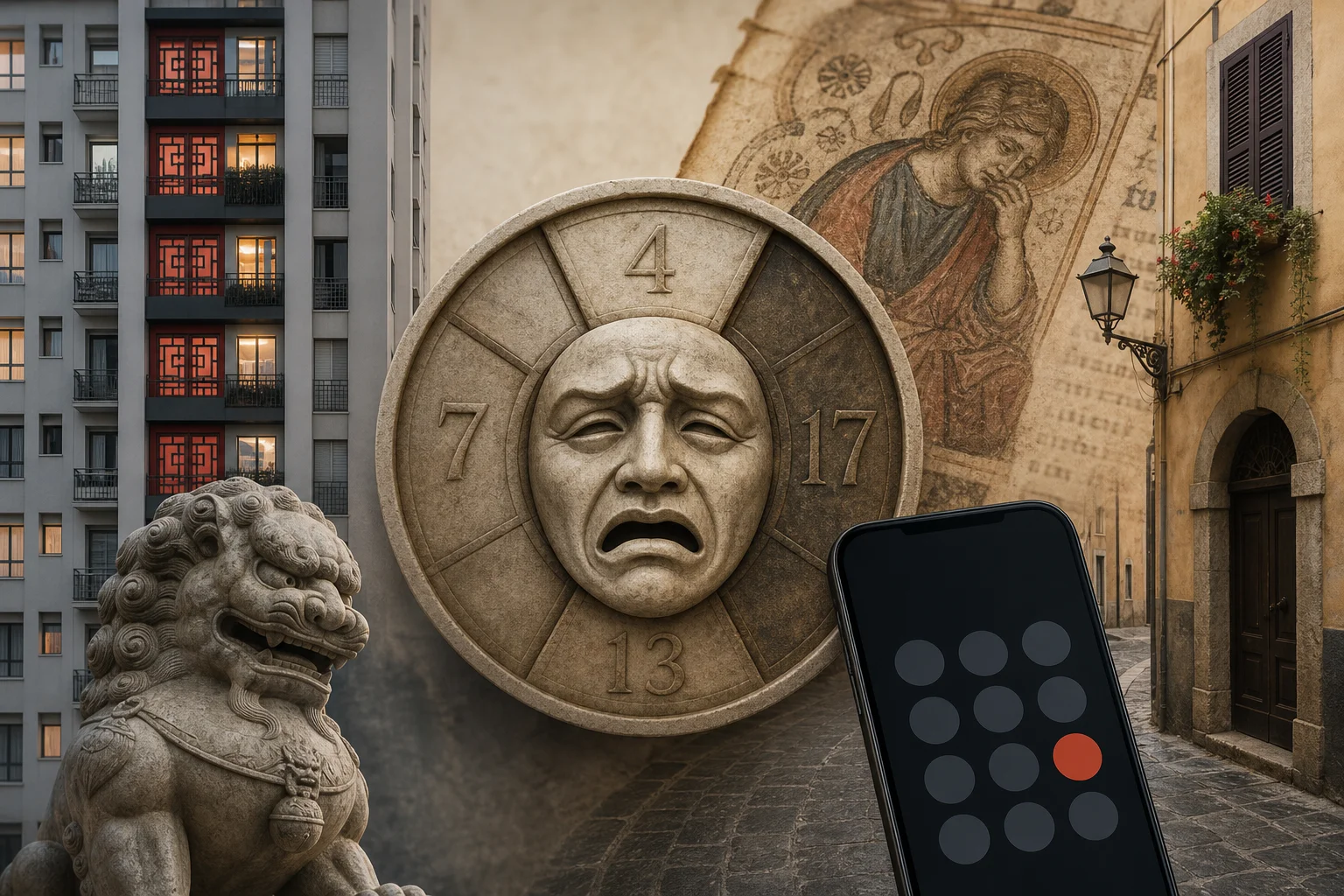
Below is a brief comparison of numbers that are most often considered bad in different countries. The table helps to quickly understand where and why such associations arose.
| Number | Where it is considered unlucky | Main reason | Where it is noticeable in everyday life |
|---|---|---|---|
| 4 | China, Japan, Korea, Vietnam | Phonetic similarity with the word "death" | Floor, room, and apartment numbers |
| 13 | Europe, USA, parts of Latin America | Christian and folk traditions | Hotels, airplanes, dates |
| 17 | Italy | Association with the Latin inscription related to death | Flight numbers, room numbers, dates |
| 39 | Afghanistan | Negative urban legend and social stigma | Car plates, phones |
| 666 | Christian culture | "Number of the beast" from Revelation | Symbolism, addresses, numbers |
| 9 | Japan | Phonetic similarity with the word "suffering" | Hospitals, gifts, room numbers |
The number 13 and the fear of Friday
The number 13 is one of the most recognizable unlucky numbers in Western culture. The fear of it is called triskaidekaphobia. Especially strong associations arise with the combination "Friday the 13th."
The origin of the superstition is explained in various ways. In the Christian tradition, the Last Supper is often referenced: there were 13 participants at the table, and Judas, who betrayed Christ, became a symbol of misfortune. Additionally, in folk culture, the number 12 was long perceived as a sign of completeness: 12 months, 12 zodiac signs, 12 apostles, 12 hours on a clock face. Therefore, 13 seemed "excessive" and disrupted the order.
Today, the fear of 13 manifests very practically. In some hotels, there is an absence of the 13th floor or room number 13. In airplanes of certain airlines, the 13th row is sometimes skipped. This is not about proven risk, but rather a desire not to upset customers.
Why Friday the 13th became a separate symbol
Friday in European tradition also had an ambiguous reputation. In the Christian context, it is associated with Christ's crucifixion. When the negative image of Friday combined with the number 13, an especially resilient symbol of an unlucky day emerged.
Popular culture intensified this effect. Books, movies, and urban legends cemented the date's image as ominous. Therefore, many people perceive it emotionally, even if they do not consider themselves superstitious.
The number 4 in East Asia
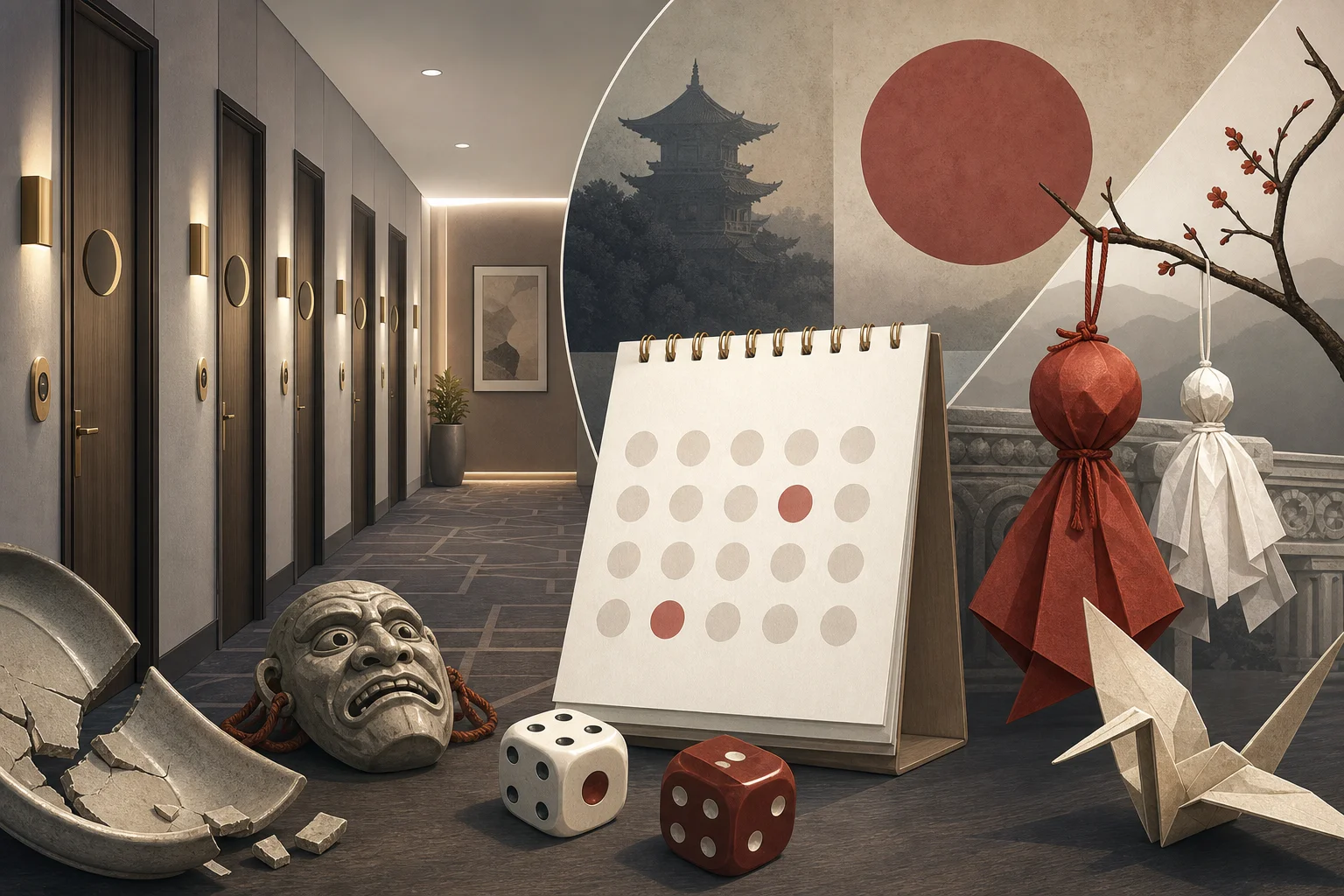
In China, Japan, Korea, and Vietnam, the number 4 is often considered unlucky due to its phonetic similarity with the word "death." This is one of the most vivid examples of how language shapes superstition.
In Chinese, the pronunciation of 4 is similar to the word for death. In Japanese, one of the readings of the number four also sounds unfavorable. Therefore, in hospitals, residential complexes, and hotels, avoidance of numbers with four is sometimes observed. This phenomenon is called tetraphobia.
The fear of the number 4 can also influence business. For instance, product series, model numbers, or gift sets are often arranged so as not to trigger undesirable associations. This is particularly important if the company operates in East Asian markets.
Where number 4 is avoided
The number four is most often not used in the following cases:
- Hospital ward numbers. In a medical context, the connection to the word "death" is perceived particularly sharply.
- Floor and apartment numbers. Some buildings skip the 4th, 14th, or 24th floor in their labeling.
- Gifts. A set of four items may be considered an unlucky gift.
- Phone numbers. Combinations with many fours may be seen as less desirable.
- License plates. In certain regions, people prefer numbers without the digit 4.
The number 17 in Italy
In Italy, the number 17 is often considered unlucky. Its reputation differs from the story of number 13. The explanation is related to Roman numerals: XVII can be rearranged to VIXI. In Latin, this means "I have lived," implying "my life is over." Such an inscription was associated with graves and death.
Because of this, Friday the 17th in Italy can be perceived as anxiously as Friday the 13th in English-speaking countries. In everyday life, this superstition manifests more mildly than the fear of the number 4 in East Asia, but it is still noticeable. Sometimes number 17 is avoided in room, flight, or seat numbers.
Interestingly, in other countries, 17 may not have negative connotations. This shows that the "unluckiness" of a number almost always depends on cultural context.
The number 666 and religious symbolism
The number 666 is known as the "number of the beast" from the Book of Revelation. In Christian tradition, it is associated with the image of evil, the antichrist, and spiritual danger. Therefore, many people avoid this combination in documents, addresses, phone numbers, or license plates.
Unlike the numbers 4 or 17, phonetic similarity is less important here than the religious text and subsequent cultural interpretation. In popular culture, 666 is often used in horror films, music, and symbolism to create a dark atmosphere.
However, attitudes toward this number are not uniform. For some, it is a serious religious sign. For others, it is simply an element of pop culture. Therefore, in international communication, it is better to consider the audience and avoid using 666 where it may cause unnecessary tension.
The number 9 in Japan
In Japan, the number 9 is sometimes seen as unfavorable because one of its readings resembles the word "suffering" or "torment." For this reason, the number nine may be avoided in hospitals, hotels, and when choosing gifts.
At the same time, the number 9 is not always viewed negatively. In various contexts, it can be neutral. However, when it comes to health, illness, or important personal events, the Japanese may prefer a more favorable combination.
This example reminds us that the same number can change meaning depending on the situation. Thus, mechanically applying superstition across all areas of life is incorrect.
The number 39 in Afghanistan
The number 39 has gained a negative reputation in Afghanistan due to an urban legend and social stigma. In some regions, it is associated with obscene hints and the questionable status of the number's owner. As a result, people might avoid car plates and phones with this combination.
This is a relatively modern example of an unlucky number. It shows that superstitions do not necessarily have ancient roots. Sometimes it is enough to have a persistent rumor, a recurring joke, or a reputational risk for a number to become undesirable.
Why do people continue to believe in bad numbers
Even in a rational society, superstitions persist. The reason is not only tradition. The human brain is inclined to seek patterns, especially in stressful situations. If an unpleasant event coincides with a particular date or number, a person may remember that coincidence.
Additionally, the confirmation bias comes into play. We notice instances that support our beliefs and ignore those that contradict them. If a person believes that 13 brings bad luck, they are more likely to recall a bad day on the 13th than an ordinary or lucky one.
There is also a social factor. If family, colleagues, or clients consider a number dangerous, it is easier to accommodate their expectations than to argue. Therefore, developers, hotels, and airlines sometimes adapt numbering to cultural habits.
How to understand the significance of an unlucky number: step-by-step approach
If you encounter a "bad" number in another country, act calmly. Here is a simple algorithm.
- Determine the country and cultural context. One number may be scary in one culture and ordinary in another.
- Check the linguistic meaning. Find out if the pronunciation of the number resembles the word for "death," "suffering," or another negative concept.
- Study religious associations. Some numbers are connected to texts, rituals, or taboos.
- Assess everyday usage. See if the number is avoided in floors, room numbers, gifts, or dates.
- Consider the audience. If the number may unsettle clients, guests, or partners, it is better to choose a neutral option.
- Do not make hasty conclusions. A superstition does not equate to a universal rule. The place, situation, and people involved are always important.
Frequently asked questions about unlucky numbers
What number is considered the unluckiest
There is no single answer. In Western culture, 13 is often mentioned, in East Asia, 4, in Italy, 17, and in Christian symbolism, 666 holds a special place. The most "unlucky" number depends on the country and tradition.
Why is the number 13 feared more than others
The number 13 became a symbol of misfortune due to religious and cultural associations. Additionally, it has been popularized by literature, film, and urban legends. Therefore, it is known even to those who do not believe in signs.
Is it true that there is no 13th floor in buildings?
Sometimes yes. In some hotels and office buildings, the 13th floor is renamed, for example, to 12A or 14. The floor physically exists, but its number is skipped in order not to disturb visitors.
Why is the number 4 associated with death
In several East Asian languages, the pronunciation of the number 4 is similar to the word "death." Therefore, four is avoided in hospitals, residential buildings, hotels, and gift sets.
Should you avoid unlucky numbers in business
If you work with an international audience, it is better to take cultural associations into account. This is not a matter of mysticism but a matter of respect for clients. Neutral numbering of a product, room, or tariff can reduce the risk of negative reactions.
How to use knowledge of numbers in life and work
Knowledge about unlucky numbers is useful in travel, negotiations, product design, and gift selection. For example, if you are booking an event for guests from China, it is better to avoid a set of four items. If you are preparing a marketing campaign for Italy, it is worth paying close attention to the number 17. And during an international product launch, it is undesirable to accidentally choose the code 666, if the audience may find it provocative.
At the same time, there is no need to turn every number into a problem. Most people have a flexible attitude toward superstitions. The main thing is to understand the context and not impose your habits on another culture.
Conclusion
Popular unlucky numbers show how closely language, religion, history, and everyday decisions are intertwined. The numbers 13, 4, 17, 666, 9, and 39 are not dangerous in themselves, but their symbolism can be important to the people around you. If you are choosing a date, number, gift, or product name, check the cultural associations in advance. This way, you will avoid awkwardness and make a more respectful, thoughtful decision.