What you need to know about numbers in numerology
Numbers in numerology are viewed as symbols through which people describe character, life cycles, strengths, and potential lessons. This is not a scientific method of prediction but an esoteric system of self-discovery and interpretation. In this article, we will explore the meanings of basic numbers, how to calculate them based on date of birth and name, what distinguishes popular indicators, and how to use numerology without inflated expectations.
What is numerology in simple terms
Numerology is a system of symbolic meanings attributed to numbers. It is based on the idea that the date of birth, name, and recurring numerical combinations can reflect an individual's personal themes. Different schools have different interpretations, but most commonly, numbers from 1 to 9 are used, along with master numbers 11, 22, and 33.
It is important to understand that numerology does not replace psychology, medicine, financial planning, or professional advice. It is better perceived as a tool for reflection. For example, calculations can highlight questions like “how do I make decisions”, “what motivates me”, and “which qualities are worth developing”.
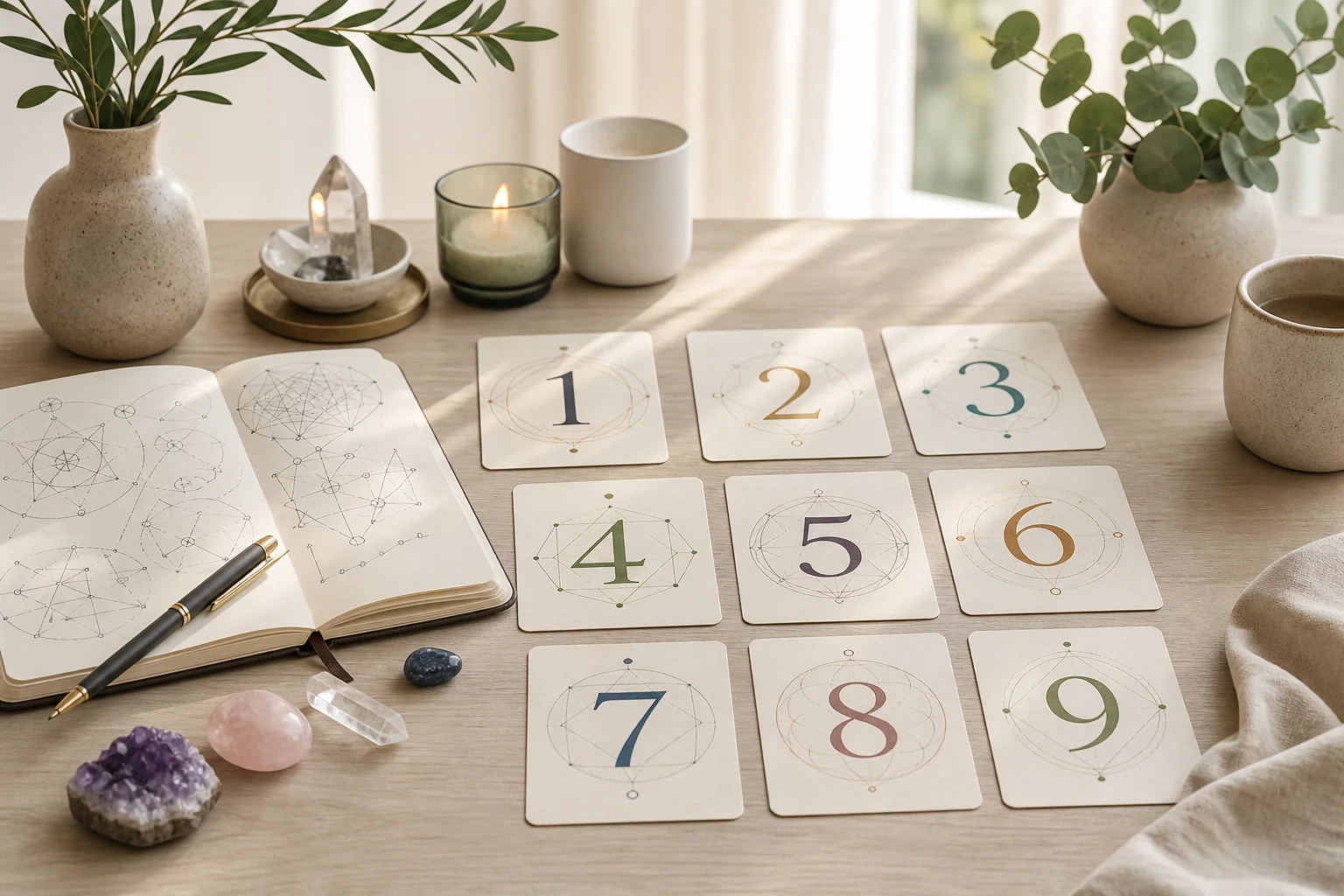
Basic numbers in numerology and their meanings
Below are common meanings of the basic numbers. This is a brief map of meanings, not a strict diagnosis of personality.
| Number | Key theme | Possible strengths | Risk on the downside |
|---|---|---|---|
| 1 | Independence | Initiative, leadership, courage | Stubbornness, egocentrism |
| 2 | Partnership | Diplomacy, empathy, tact | Dependence on others' opinions |
| 3 | Self-expression | Sociability, creativity, humor | Superficiality, distraction |
| 4 | Structure | Practicality, discipline, reliability | Rigidity, fear of change |
| 5 | Freedom | Flexibility, curiosity, energy | Inconstancy, impulsiveness |
| 6 | Care | Responsibility, family, harmony | Control, excessive nurturing |
| 7 | Search for meaning | Analytical, depth, intuition | Closed-off, distrustful |
| 8 | Material realization | Management, ambitions, strategy | Pressure, dependence on status |
| 9 | Completion and humanism | Compassion, wisdom, broad-mindedness | Self-sacrifice, dramatization |
Number 1
The unit is associated with beginnings, will, and personal initiative. In numerological interpretations, it often indicates a desire to act first, create one's own, and take responsibility. In a balanced form, this number helps to demonstrate confidence. However, under tension, it can manifest as impatience and a drive to control everything.
Number 2
The two symbolizes connection, sensitivity, and the ability to see both sides of a situation. Its theme is collaboration. People with a strong two in their calculations are often attributed with diplomacy and attentiveness. But if the energy of the number manifests unharmoniously, a person may become overly dependent on approval.
Number 3
The three is associated with speech, creativity, and ease. This number is often linked to artistry, learning through communication, and the ability to inspire. However, it is important for the three to develop focus, otherwise ideas may remain at the level of conversation.
Number 4
The four is a symbol of order, labor, and a stable foundation. It helps to build a system, follow through on tasks, and rely on facts. A weak point is excessive caution. Therefore, the key lesson of the four is often formulated as: maintain stability, but do not fear renewal.
Number 5
The five is responsible for movement, experience, and freedom of choice. In numerology, it is associated with changes, travel, communication, and quick adaptation. However, freedom requires responsibility. Without it, the five can manifest as chaos and an unwillingness to finish what is started.
Number 6
The six is associated with care, home, beauty, and responsibility. This number often describes the desire to help, create comfort, and support loved ones. It is important not to turn care into control. The best manifestation of the six is mature support without self-sacrifice.
Number 7
The seven is a number of analysis, inner search, and observation. It is associated with an interest in knowledge, exploration, spiritual questions, and solitude. A strong seven can provide depth of thought. However, it is important not to withdraw into isolation and not to replace live experience with endless doubts.
Number 8
The eight often relates to themes of power, money, results, and resource management. In its positive manifestation, it is strategic thinking, the ability to take responsibility, and to see long-term benefits. On the downside, the eight can manifest as rigidity and evaluating oneself solely through achievements.
Number 9
The nine symbolizes the completion of a cycle, wisdom, and a broad perspective. It is associated with compassion, social ideas, art, and a desire to be helpful. At the same time, it is important for the nine to maintain boundaries. Otherwise, helping others may become a way to avoid one's own tasks.
Master numbers 11, 22, and 33
In some schools of numerology, the numbers 11, 22, and 33 are not reduced immediately to 2, 4, and 6. They are referred to as master numbers. It is believed that they enhance the theme of the base number and add more tension, responsibility, or potential.
- 11 is associated with intuition, inspiration, and subtle perception. It is important to translate ideas into practice.
- 22 is called the number of major construction. Its theme is to materialize big plans through system and discipline.
- 33 is associated with service, mentorship, and mature care. The main risk is rescuing and overexertion.
If the calculations yield a master number, it is useful to look at both levels: for example, 11 and 2, 22 and 4, 33 and 6. Thus, the interpretation will be more balanced.
How to calculate the life path number
The life path number is one of the most popular indicators in numerology. It is calculated from the full date of birth. Typically, it describes the main theme of experience, the habitual way of moving through life, and qualities that are worth developing.
Step-by-step calculation:
- Write down the date of birth in the format day, month, year. For example: 24.08.1991.
- Add all the digits of the date: 2 + 4 + 0 + 8 + 1 + 9 + 9 + 1 = 34.
- Reduce the sum to a single digit: 3 + 4 = 7.
- The resulting number will be the life path number. In this example, it is 7.
- If at an intermediate stage you obtained 11, 22, or 33, check if your numerology school includes master numbers.
This calculation is convenient in that it does not require additional tables. However, it is better to interpret it together with other indicators, rather than separately.
How do the numbers of destiny, soul, and personality differ?
The names of the indicators may vary. But in popular Pythagorean and Western traditions, three calculations based on the name are often encountered.
Destiny number
The destiny number, or expression number, is usually calculated from the full name. Letters are assigned numerical values, then the sums are reduced. This indicator is associated with talents, the style of realization, and how a person manifests itself in their affairs.
Soul number
The soul number is often derived from the vowels in the name. It is interpreted as inner motivation, desires, and emotional needs. It can show what is important for a person to feel, even if they behave differently externally.
Personality number
The personality number is usually calculated from the consonants. It is connected with first impressions, the image in the eyes of others, and the habitual social mask. This indicator does not describe the full depth of character, but helps to look at the external presentation.
How to properly relate to interpretations
To ensure that numbers in numerology are useful rather than confusing, it is important to follow several rules.
Firstly, avoid literal predictions. The phrase “the eight will always be wealthy” is incorrect. A more accurate approach is: “the eight raises themes of management, goals, and responsibility for resources.”
Secondly, consider the context. The same number can manifest differently in profession, relationships, and personal habits. For example, the four at work may bring reliability, while in relationships it may present a need for rules and predictability.
Thirdly, do not use numerology to evaluate other people without their consent. The symbolic system can be a reason for dialogue but not a tool for pressure.
Finally, check interpretations with practice. If the description of the number helps to better understand your reactions and choose actions, it is useful. If it provokes fear or a sense of doom, it should be taken critically.
Frequently asked questions about numbers in numerology
Which number is the strongest in numerology?
There is no single “strongest” number. Each number describes its theme. Master numbers 11, 22, and 33 are often considered more tense and potentially significant, but they do not make a person better or more successful automatically.
What does it mean if I often see the same numbers?
Recurring numbers, such as 11:11 or 22:22, are referred to in esoteric interpretations as hints or synchronicities. Practically, it is useful to see them as a reason to pause and ask yourself: what am I thinking about right now, what decision am I postponing, what should I pay attention to?
Can I change my numerology number?
The date of birth does not change, so the life path number remains the same. The indicators of the name may change if the name or surname is changed, but this does not guarantee changes in life. Real changes depend on decisions, habits, and actions.
Does compatibility by numbers work?
Numerological compatibility can show different communication styles and possible points of tension. But it does not determine the quality of relationships. Much more important are respect, honesty, emotional maturity, and the ability to reach agreements.
Practical application of numerology
Numerology can be used gently and consciously. For example, create a personal map consisting of three points: life path number, strong qualities of the number, and one skill for development. Then choose an action for the week.
If your number is 3, an action could be to complete one creative project. If 4 — organizing finances or schedule. If 7 — an hour without a phone for reading, analysis, or quiet planning. This way, the symbolism turns into specific practice.
Conclusion
Numbers in numerology help to view personality, choices, and life themes through the language of symbols. Use them as a tool for self-reflection: calculate your life path number, explore the meanings of basic numbers, and choose one practical action that will support your strengths today.