Numerology tables and their use: practical guide
Numerology tables and their use help organize calculations related to the date of birth, name, and key life cycles. In this article, we will explore the types of tables in numerology, how to use them, which numeric meanings to consider, and where it's important not to cross the line between symbolic interpretation and real decisions. This material is suitable for beginners who want to keep neat records, compare results, and see the overall picture without chaotic calculations.
Numerology relates to esoteric practices. Its conclusions are not a scientific forecast and do not replace consultations with specialists. However, tables can be useful as a tool for self-reflection: they help to ask questions, notice recurring themes, and structure personal observations.
What are numerology tables?
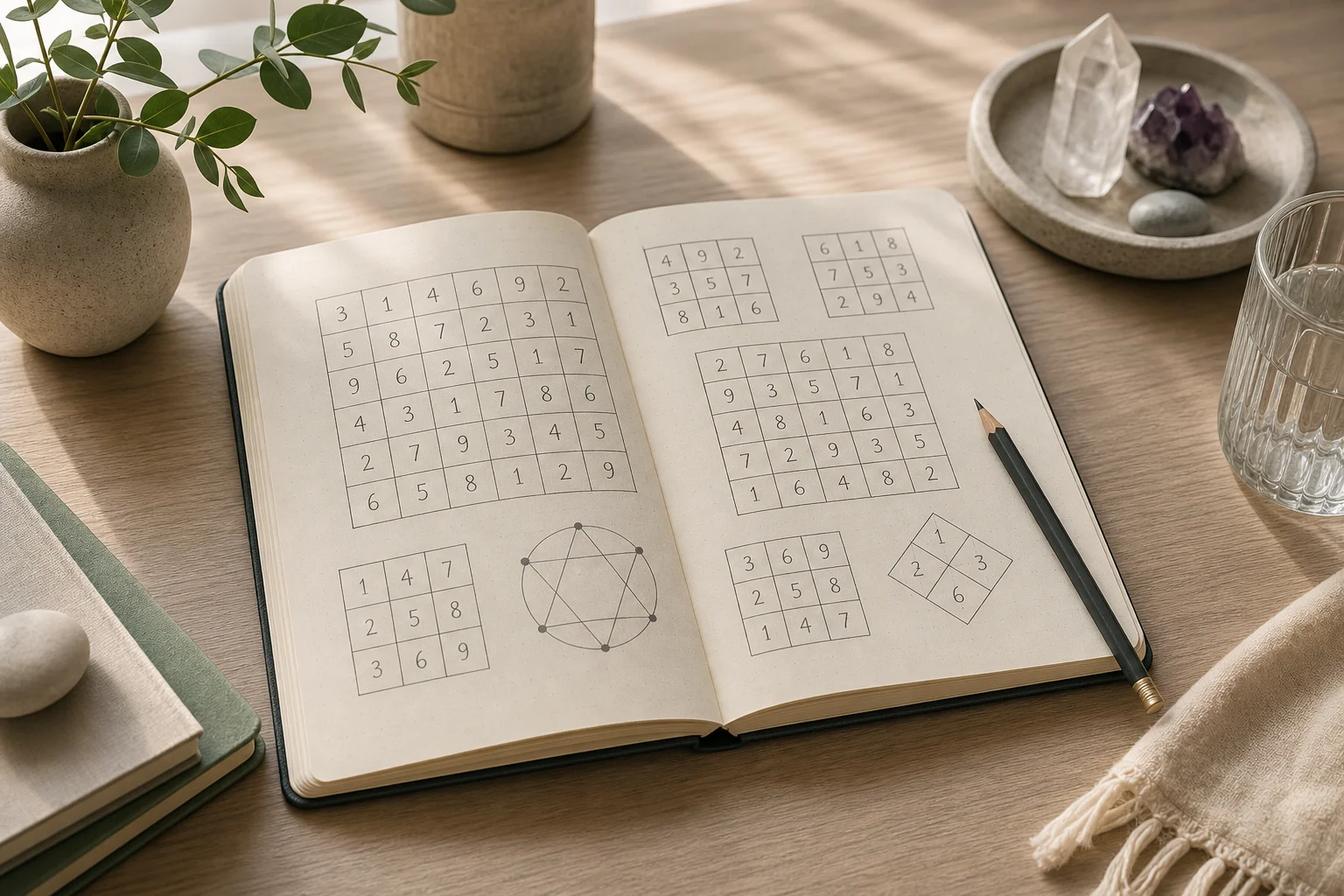
A numerology table is a scheme in which numbers obtained from the date of birth, name, or another set of data are entered. These numbers are then interpreted according to the chosen system. The table makes the process transparent: you can see where each value came from and how it relates to other indicators.
Most often, tables are used for three tasks:
- calculating basic personality numbers;
- analyzing strengths and weaknesses in character;
- tracking personal years, months, and periods.
It is important to understand: different schools of numerology may use different rules. For example, in the Pythagorean tradition, letters are translated into numbers from 1 to 9, while in some systems, master numbers 11, 22, and 33 are considered separately. Therefore, before calculating, it is advisable to choose one methodology and not mix it with others.
Main types of numerology tables
There are many formats, but for practice, it's sufficient to start with a few basics. They cover most popular inquiries: "what is my destiny number," "how to decode a name," and "what does personal year mean."
Table of meanings of numbers from 1 to 9
This is the foundation of most calculations. Each number is assigned symbolic qualities. Below is a brief working scheme that is convenient to keep handy.
| Number | Key themes | Possible shadow |
|---|---|---|
| 1 | independence, initiative, leadership | stubbornness, isolation |
| 2 | partnership, diplomacy, sensitivity | dependence, doubts |
| 3 | creativity, communication, ease | superficiality, distraction |
| 4 | order, hard work, structure | rigidity, fear of change |
| 5 | freedom, movement, experience | impulsiveness, instability |
| 6 | care, family, responsibility | control, self-sacrifice |
| 7 | analysis, search for meaning, intuition | closedness, distrust |
| 8 | resources, management, result | pressure, excessive control |
| 9 | humanism, completion, wisdom | dramatization, fatigue |
This table should not work as a label. It’s better to perceive it as a dictionary of themes. For example, the number 4 does not mean that a person is "boring." It can indicate the importance of stability, systems, and long-term planning.
Table of letters and numbers
For name analysis, a correspondence between letters and numbers is used. In Russian-language practice, an adapted table is often applied, where letters are distributed in a cycle from 1 to 9. It is important to use the same table for all calculations; otherwise, the result will be inconsistent.
Example of the principle:
| Number | Letters |
|---|---|
| 1 | А, И, С, Ъ |
| 2 | Б, Й, Т, Ы |
| 3 | В, К, У, Ь |
| 4 | Г, Л, Ф, Э |
| 5 | Д, М, Х, Ю |
| 6 | Е, Н, Ц, Я |
| 7 | Ё, О, Ч |
| 8 | Ж, П, Ш |
| 9 | З, Р, Щ |
Before working, decide which form of the name to take: the full name on the documents, the name at birth, or the name that the person uses daily. For self-observation, you can compare the options, but in the main table, it’s better to fix one approach.
Psychomatrix by date of birth
The psychomatrix is a popular format where the digits of the date of birth are distributed across cells. Usually, the counts of ones, twos, threes, and so on are analyzed. This table shows not "destiny," but a symbolic profile: which themes are expressed more strongly and which require attention.
For example, the date 14.07.1992 contains the digits 1, 4, 0, 7, 1, 9, 9, 2. Zeros are often not included in the matrix but are noted in comments as an amplifier or pause, depending on the school. Then, repetitions are counted: two ones, one two, one four, one seven, and two nines.
Table of personal periods
Another useful tool is the table of personal year, month, and day. It is used for planning and reflection. For instance, the personal year can be calculated as follows: birthday + birth month + current year, then reduce the sum to a number from 1 to 9.
If the date of birth is July 14 and the year is 2026, the calculation will be as follows: 1 + 4 + 7 + 2 + 0 + 2 + 6 = 22. Next, two approaches are possible: keep 22 as a master number or sum 2 + 2 = 4. The chosen rule should be applied consistently.
How to use a numerology table step by step
Below is a simple order of work that reduces the risk of mistakes and helps to get a clear interpretation.
- Choose a calculation system. Decide whether to use classical reduction to 1-9, whether to consider 11, 22, and 33, which letter table to take.
- Write down the initial data. Indicate the date of birth, full name, or another parameter. Do not calculate "by memory."
- Break down the data into digits. Carefully sum the numbers. If working with a name, first translate each letter into a number.
- Reduce the result to the desired format. For example, 37 becomes 3 + 7 = 10, then 1 + 0 = 1. If the system retains master numbers, note this separately.
- Enter the values into the table. This way, you will see not only the final number but also the entire path of calculation.
- Compare several indicators. Do not draw conclusions based on one number. Look at the date of birth, name, personal year, and recurring themes.
- Write the interpretation in your own words. It is better to phrase the conclusion as a question or observation: "Where do I need structure?" instead of "I have a bad four."
- Test it in practice. Return to the record in a month. Note what was helpful and what did not match the experience.
This approach makes numerology less dogmatic and more practical. The table becomes a diary of observations rather than a set of final judgments.
Example of calculation by date of birth
Let’s analyze a conditional example. Suppose the date of birth is 23.11.1990.
First, we calculate the life path number:
2 + 3 + 1 + 1 + 1 + 9 + 9 + 0 = 26
2 + 6 = 8
The final number is 8. In symbolic interpretation, it is associated with resource management, responsibility, results, and the ability to build a material foundation. In the practical diary, this can be translated into questions:
- How do I relate to money and obligations;
- Can I delegate;
- Where do I confuse control and responsibility;
- What long-term goals require structure.
Then a mini-table of the digits of the date can be composed:
| Digit | Count in date | Theme for observation |
|---|---|---|
| 1 | 3 | will, independence, start |
| 2 | 1 | contact, sensitivity |
| 3 | 1 | expression, communication |
| 9 | 2 | experience, completion, broad vision |
| 0 | 1 | pause, potential, empty space in the system |
This example shows why tables are more convenient than oral interpretations. You see not only the final eight but also the composition of the number: many ones, two nines, the presence of zero. This creates a more comprehensive picture.
How to interpret results without errors
The main mistake of beginners is to perceive the table literally. Numerology values do not fully describe a person. They provide a language for reflection. Therefore, it’s useful to follow a few rules.
Firstly, do not draw conclusions based on one indicator. If the name number indicates creativity, while the date of birth emphasizes discipline, this is not a contradiction. It may be important for a person to manifest ideas through a system.
Secondly, avoid negative labels. There are no "bad" numbers in tables. Each value has a strong side and a complex side. For example, 5 can manifest as flexibility but may also appear as inconsistency. It all depends on the context.
Thirdly, verify interpretations with life facts. If the description doesn’t resonate, there’s no need to force yourself into it. It’s better to write neutrally: "I don’t observe it yet."
Fourthly, do not use numerology for decisions where facts are needed: treatment, legal issues, investments, security. In such cases, the table can only serve as a reason to think, but not as a basis for action.
Where to apply numerology tables
Numerology tables are most often used in personal work. They help structure reflections, especially if a person keeps a journal, plans the year, or studies their habitual reactions.
Practical applications:
- self-analysis: identify recurring themes and formulate questions for yourself;
- planning: correlate personal year with goals, not forgetting about real circumstances;
- name analysis: compare full name, short form, and creative pseudonym;
- journal work: track how themes of numbers manifest in events;
- learning numerology: verify calculations and not lose original data.
Tables are also convenient for consultations if a specialist needs to show the client the logic of the calculation. Transparency increases trust: the person sees that the conclusion is not taken "out of the air," but based on certain rules of the chosen system.
Frequently asked questions about numerology tables
Can I create a numerology table myself?
Yes. For a basic calculation, you only need a date of birth, the chosen table of values, and accurate records. Start with the life path number and the table of date digits. You can then add the name and personal periods.
Which numerology table is the most accurate?
There is no single "most accurate" table because numerology is not a scientific method of measuring personality. It's better to choose a system that is clear to you and apply it consistently. Then the results will be easier to compare.
Do I need to consider master numbers 11, 22, and 33?
It depends on the school. If you are just starting, you can first reduce all numbers to a range from 1 to 9. Later, you can add master numbers and note them separately without changing old calculations retrospectively.
How often can you recalculate tables?
The basic numbers from date of birth do not change. The name table is recalculated when the name changes or when comparing different forms of address. Personal years and months are updated according to the calendar, usually once a year or month.
Can tables be used for compatibility?
Yes, if viewed as a symbolic analysis of dynamics rather than as a verdict on relationships. For real compatibility, communication, values, boundaries, and readiness to resolve conflicts are more important.
Tips for convenient table management
To avoid chaos in calculations, use a single template. A paper notebook, spreadsheet, or note in an app will work. The main thing is to keep the calculation date, system, and original data.
A useful structure for records:
- initial data;
- calculation method;
- intermediate sums;
- final numbers;
- brief interpretation;
- personal observations over time.
Moreover, create a separate dictionary of meanings. For each number, write not only the ready interpretation but also your associations. After a few months, you will see which interpretations are truly helpful and which sound too general.
Conclusion
Numerology tables are useful when you use them carefully: choose one system, record calculations, compare several indicators, and check conclusions with experience. Start with a simple birthdate table, add numeric meanings, and keep observations for at least a month. This way, you will get not a set of random predictions, but a clear tool for self-reflection and more conscious planning.