How numerology and astrology are connected: a clear explanation
How are numerology and astrology connected? This question often arises for people interested in self-discovery, horoscopes, and symbolic systems. Both practices use the date of birth to look for patterns in personality and life cycles, but they work with different tools. Astrology relies on the position of planets, zodiac signs, and houses. Numerology examines the numbers derived from the date of birth and the name. Together, they can provide a more layered interpretation of personality if approached as a language of symbols rather than as a precise science.
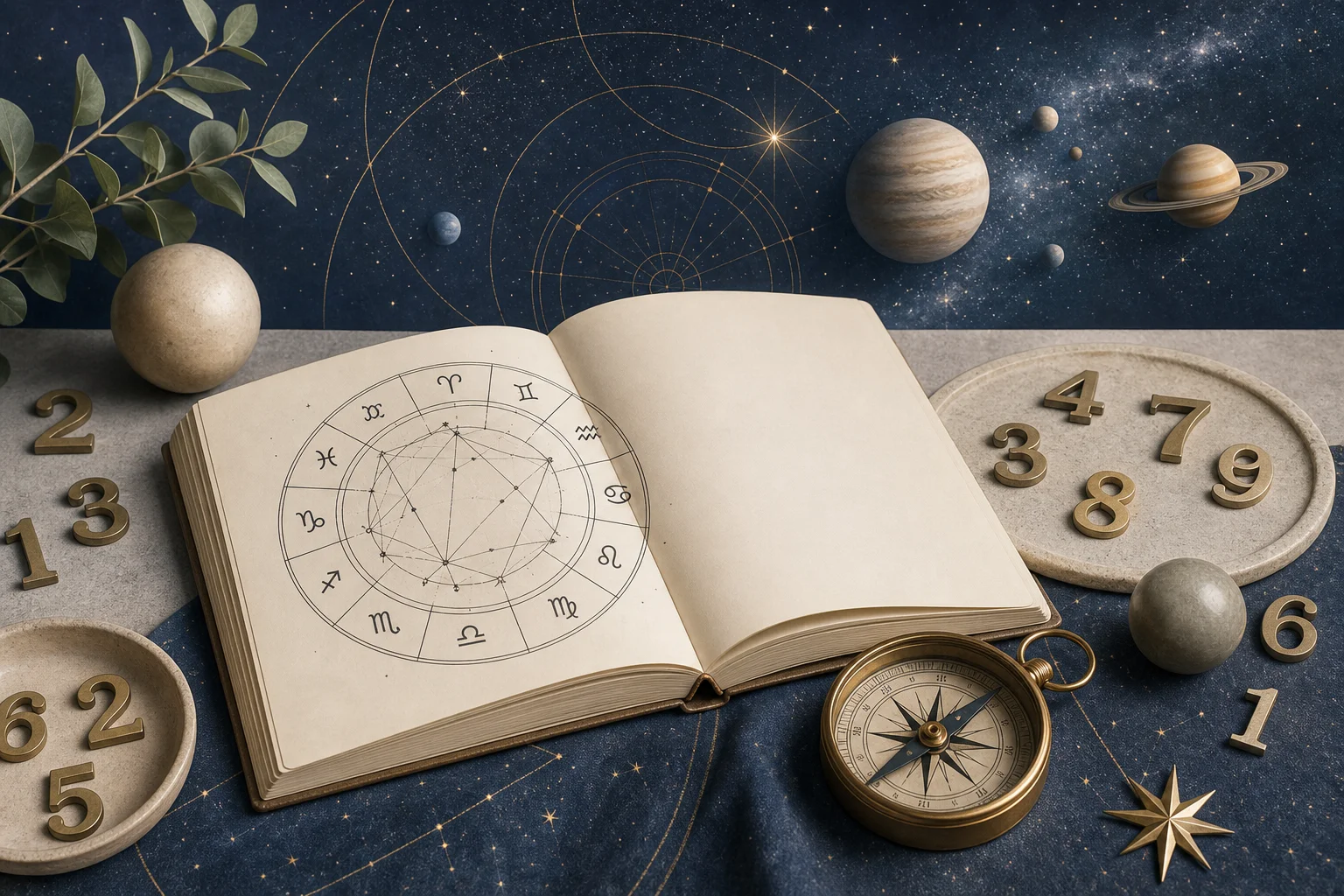
What astrology studies
Astrology is a system of interpretation that links celestial bodies to psychological qualities, events, and life periods. The main tool of an astrologer is the natal chart, which is built using the date, exact time, and place of birth.
In the chart, the following are usually analyzed:
- the Sun sign, which is associated with basic will and self-perception;
- the Moon sign, describing emotions, habits, and needs;
- the ascendant, showing behavior style and first impression;
- planets in signs and houses;
- aspects between planets, that is, angular relationships;
- transits and progressions used for analyzing periods.
It is important to understand that modern popular astrology often boils down to the zodiac sign based on the Sun. However, a professional analysis is much broader. Two people born under the same sign can have completely different charts due to the time and place of birth.
What numerology studies
Numerology is a symbolic system in which numbers are viewed as carriers of meanings. In the classical approach, the date of birth and the person's name are most commonly used. These yield key indicators: life path number, soul number, destiny number, name number, and others.
The most well-known indicator is the life path number. It is calculated from the full date of birth. For example, the date 14.09.1992 adds up as follows: 1 + 4 + 0 + 9 + 1 + 9 + 9 + 2 = 35, then 3 + 5 = 8. In this system, the number 8 is often associated with themes of strength, control, responsibility, and material results.
Numerology is easier for initial study because it does not require a complex sky chart. However, its interpretations also depend on the school. Pythagorean, Chaldean, Kabbalistic, and modern systems can place different emphases.
The main connection between numerology and astrology
Numerology and astrology are linked in that both use the date of birth as a symbolic entry point. They suggest that the moment a person is born can be considered as a special code. In astrology, this code is expressed through the position of the planets. In numerology — through numerical values.
There is a deeper similarity as well. Both systems:
- work with archetypes and symbols;
- describe strengths and growth areas;
- use cycles and periods;
- help formulate questions about character, choices, and goals;
- are not scientifically proven methods of prediction.
It is the last point that is especially important. Neither astrology nor numerology is supported by scientific consensus as methods for accurately predicting events or objectively measuring personality. Therefore, it is wiser to apply them as tools for reflection, cultural tradition, or personal interest.
How these systems differ
Although numerology and astrology often coexist in esotericism, they differ in the logic of analysis.
| Criterion | Astrology | Numerology |
|---|---|---|
| Main data source | Date, time, and place of birth | Date of birth and name |
| Main tool | Natal chart | Numerical chart or matrix |
| Symbolic language | Planets, signs, houses, aspects | Numbers and their meanings |
| Level of detail | High, depending on exact time | Usually simpler and faster |
| Focus | Psychology, cycles, life areas | Personal qualities, tasks, rhythms |
| Ease of entry | Medium or high | Low or medium |
In simpler terms, astrology shows structure through the sky, while numerology does so through numbers. The former answers the question